

On 9 February 2026, Nigeria’s pension regulator raised the ceiling on shares. It was a technical notice, four fund classes, a few percentage points each, Fund I up to 35 per cent, Fund II to 33, Fund III to 15. Nobody covered it as news. But the reasoning attached to it reads close to a confession.
Five months earlier, the National Pension Commission had rewritten its investment regulation with the opposite intention. The September 2025 overhaul existed to push retirement money out of government paper and into the productive economy. Private equity ceilings went from 5 per cent to as much as 15 across some funds. Twelve qualifying tests were written for private equity managers. Room was made for infrastructure.
Then the fund administrators went shopping and found the shelves bare. PenCom’s February addendum said so in the flat language regulators use for awkward facts: there were not enough qualifying alternative assets in existence, the allocation was going unused, and managers were sitting on cash they could not deploy. So the Commission did the only thing left to it and let them buy more listed shares instead.
A government had removed a constraint and discovered it was never the binding one.
That discovery is the most instructive thing to happen in African development finance this year, and it is being almost universally misread. The familiar account of why African pension money does not build African things is a story about demand: timid regulators, conservative trustees, narrow mandates, fiduciary fear. February’s addendum points somewhere else entirely.
A pension fund cannot buy a road. It cannot buy a solar mini-grid, a cold-storage network, a fibre backbone or a three-hundred-unit housing estate. What a pension fund can buy is a security, a rated, registered, listed, minimum-size instrument with a trustee, a servicer, a defensible price and an audit trail. Africa has a long pipeline of the first thing and almost no industry devoted to converting it into the second. The missing piece is not capital. It is not permission. It is a factory.
Fifty-seven per cent that is really a single bet
Start with the shape of the money. Nigeria’s contributory pension system held ₦30.70 trillion in June 2026 across 11.32 million retirement savings accounts, a pool that grew by roughly ₦6.08 trillion , a quarter of itself , in twelve months. It is the largest pool of long-term domestic savings in West Africa and, by any fair measure, a policy success. Two decades ago Nigeria’s public pension arrangements were a byword for unfunded promises.
Look at where the money sits and the success gets complicated.

Fifty-seven per cent of the system is lent to a single borrower. Add money-market instruments, which are mostly bank deposits, and the banks are themselves heavy holders of treasury bills, and the effective exposure to the Federal Government is higher than the chart admits. Meanwhile the categories that finance productive assets come last: infrastructure funds at 1.07 per cent, private equity at 0.86, real estate trusts at 0.38.
1.07% The share of Nigeria’s ₦30.7 trillion pension pool held in infrastructure funds, June 2026. PenCom is not blind to this. Reviewing the first quarter of 2026, the Commission warned in its own report that a portfolio anchored that heavily in federal securities preserves capital and generates a steady carry but caps the system’s ability to beat inflation across a working lifetime. It is an unusual admission for a prudential regulator, and it is correct.
Kenya’s mix is less extreme and pointed the same way. The retirement benefits industry crossed KSh3 trillion for the first time in June 2026, reaching KSh3.167 trillion, of which KSh1.5 trillion, 46.35 per cent, sat in government securities. At the end of 2025, when the Retirement Benefits Authority last published a full breakdown, corporate bonds accounted for 0.43 per cent of the entire industry. Not 4.3. Zero point four three.
Ghana has already run the experiment to its conclusion. When the government launched its domestic debt exchange in December 2022, roughly 85 per cent of Ghanaian pension assets were in government securities, by the account of the National Pensions Regulatory Authority’s own deputy chief executive. Organised labour threatened a general strike and won an exemption within seventeen days. The exemption did not hold in full: in September 2023 pension bondholders accepted a separate arrangement, on gentler terms than other creditors, with maturities pushed to 2027 and 2028, and roughly GH¢31 billion of pension holdings restructured. What the episode exposed was not a debt problem. It was a concentration problem wearing the costume of prudence.
When government coughed, we all caught a cold.
David Tetteh-Amey Abbey, Deputy Chief Executive, National Pensions Regulatory Authority, Ghana, on the pension sector's exposure during the debt exchange
Two years on, Ghana’s pension portfolios still held about 78 per cent in government securities and under 1 per cent in alternatives. The lesson was learned and could not be acted on, which is precisely the puzzle.
What a trustee is actually allowed to hold
Here is where most commentary on this subject goes wrong. It treats “pension funds should invest in infrastructure” as an allocation decision, as though a trustee could wake up, decide the country needs power, and wire money to a power project. That is not how the plumbing works, and the gap between the two is the whole story.
Read Nigeria’s investment regulation as a manufacturing specification rather than a list of prohibitions and it becomes clear what a pension fund is being asked to buy. An infrastructure bond must carry an investment-grade rating from a registered agency. It must be tradeable on an exchange registered with the Securities and Exchange Commission. Its face value must not be less than ₦10 billion. An infrastructure fund must have satisfactory pre-defined exit routes , a listing, a trade sale, a sale to another infrastructure fund , written down in advance. Each of those clauses is defensible on its own. Together they define a product.
Now consider a real asset: a twelve-megawatt solar plant with a signed offtake agreement, or a cold-chain operator serving three states. It has revenue. It has a contract. It may well be a better credit than half the listed equities a pension fund is free to buy tomorrow. What it does not have is a rating, a prospectus, a registered trustee, a listing, an exit route on paper, or a balance sheet large enough to justify the two hundred million naira and eighteen months it takes to acquire them. It is an asset. It is not a security. And the distance between those two words is measured in legal fees, rating-agency mandates, audited accounts, structuring work and time.
Someone has to cover that distance. Somebody has to do the origination, the credit work, the documentation, the rating engagement, the listing, the guarantee , and then do it again, and again, until doing it becomes routine and cheap. That work is an industry in its own right, distinct from building projects and distinct from managing money. Call it asset manufacturing: the business of converting real-economy cash flows into instruments that a regulated fiduciary is permitted to hold.Africa’s development-finance conversation has spent fifteen years on the two ends of the chain , project preparation at one end, capital mobilisation at the other , and almost nothing on the middle. The Africa Finance Corporation put it plainly when it published its 2026 infrastructure report in Nairobi: on its numbers, domestic pension and insurance assets crossed a trillion dollars for the first time in 2025, and the binding problem had shifted. Its chief executive, Samaila Zubairu, framed it in a sentence: “The constraint is no longer capital , it is intermediation.” That is the right diagnosis. What it leaves open is why, when the economics look so obvious, nobody builds the middle.
Kenya’s savings are thirty times the market they can buy from
The clearest way to see the size of the gap is to put the pool next to the shelf.
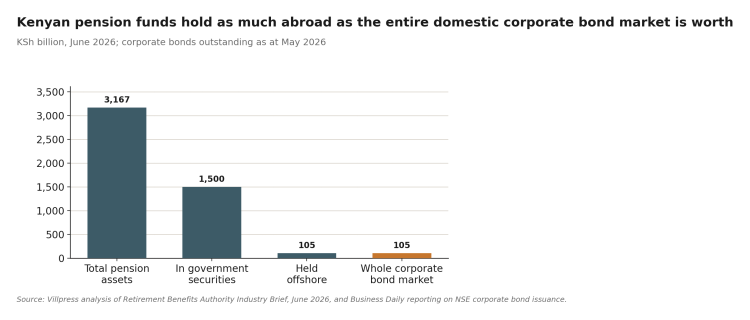
The coincidence in the last two bars is not a coincidence. Kenyan schemes moved KSh104.99 billion offshore by June 2026, a quarter more than a year earlier, into global technology and developed-market funds run by managers like BlackRock and Franklin Templeton , and still sat at around 3.3 per cent against a regulatory ceiling of 15. Given headroom and nothing domestic worth buying with it, long-term savings leave the country. That is not a failure of patriotism. It is a rational response to an empty shelf.
The shelf emptied for reasons worth remembering. Between 2015 and 2018 a run of Kenyan issuers , Imperial Bank, Chase Bank, Nakumatt, ARM Cement, Real People , defaulted on more than KSh10 billion of bonds and commercial paper, and bondholders discovered there was no clear compensation mechanism and no quick recourse. Issuance stopped for years. Surviving borrowers redeemed and went back to bank loans, shareholder funding and development finance. The market did not shrink because Kenyan companies stopped needing capital. It shrank because one cohort of failures destroyed the instrument.
There is a genuine recovery underway, and it deserves to be stated as clearly as the problem. Since March 2025 the Kenya Mortgage Refinance Company, Linzi Finco, East African Breweries, Safaricom and I&M Bank have all issued into strong demand; I&M sought KSh10 billion, received bids of KSh23.2 billion and took KSh13. Outstanding corporate bonds crossed KSh105 billion for the first time in 2026, roughly quadrupling in a year. That is what restarting a factory looks like. It is also, at the pace shown, roughly three per cent of the pool it is meant to serve.
The factory exists. It runs at a hundredth of the required speed.
This is not a theoretical problem with a theoretical solution. The solution was built in Nigeria nine years ago, and it works.
InfraCredit was established in 2017 by the Nigeria Sovereign Investment Authority and GuarantCo, with $25 million of contingent capital, to do exactly one thing: wrap naira infrastructure bonds in a guarantee strong enough to make them investment grade, so that pension funds could buy them without breaching their own rules. It was the first local-currency guarantee facility of its kind aimed at frontier-market infrastructure. It has since been copied , InfraZamin in Pakistan, Dhamana in Kenya , and it listed its own shares on Nigeria’s NASD exchange in April 2025.
The results vindicate the model. By the end of 2025, InfraCredit’s guarantees had given twenty-seven infrastructure companies first-time access to the domestic debt market, raising about ₦322.23 billion. The average tenor on those issues was eleven years, against a market average of 3.2 years for unguaranteed paper , which is to say the guarantee did not merely improve pricing, it created a duration that did not previously exist in naira. Pension funds were the largest buyers, taking more than half. When the instrument is manufactured to specification, the money appears. Every time.
Now look at the production rate.
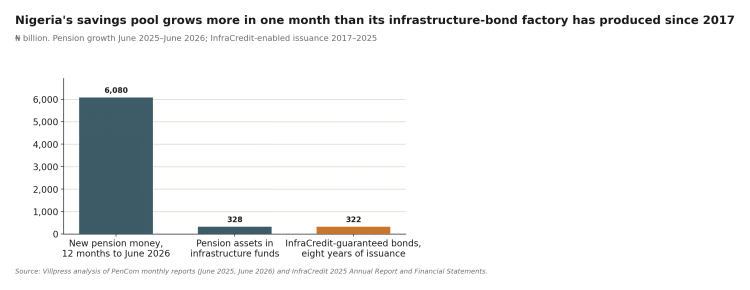
Nigeria’s pension system takes in roughly ₦507 billion of new money a month. Its purpose-built machine for turning projects into pension-eligible securities has produced ₦322 billion in total since 2017. The mismatch is not marginal. It is two orders of magnitude, and no amount of regulatory permission closes it, because permission is not the input that is scarce.
South Africa proves that last point more cleanly than anywhere else on the continent, because South Africa has the deepest market and the most generous rule. Amendments to Regulation 28, gazetted in July 2022 and effective from January 2023, defined infrastructure as an asset class for the first time and set the ceiling at 45 per cent of a fund’s assets. Private equity was split out from hedge funds and raised to 15 per cent. Nearly four years later, institutional allocations to infrastructure remain in low single digits.
Mich Nieuwoudt of Gaia Capital, speaking to Daily Maverick this month, put the shortfall down to institutional inertia and knowledge gaps, and located the decision precisely: it rests with two parties, the asset consultants and the trustees.
No one is paid to learn a new asset class.
Mich Nieuwoudt, executive chairman, Gaia Capital
That line deserves to be read as an economic statement rather than a complaint. An asset consultant is paid to recommend allocations from a defensible menu. A trustee is paid , usually very little, often nothing, to approve them. Neither earns anything from the eighteen months of unfamiliar work required to underwrite a first infrastructure transaction, and both carry career risk if it goes wrong. The returns to building capability accrue to the market; the costs fall on individuals. That is the textbook shape of a public good that private actors will systematically under-supply, and it sits on the demand side of the gap exactly as the origination cost sits on the supply side. The factory is missing at both ends of the same conveyor.
The sovereign is not only the borrower, It is the competitor.
There is an objection to everything above, and it is a serious one: perhaps there is no manufacturing problem at all, and trustees are simply doing arithmetic.
In September 2026 Nigeria’s Debt Management Office sold a new ten-year bond at 16.79 per cent. Inflation was running near 16 per cent. That is a risk-free naira instrument, perfectly liquid, held to maturity without a mark-to-market argument, requiring no credit committee and no new expertise, paying a small positive real return. An infrastructure bond must clear that hurdle and then add a credit premium and an illiquidity premium on top , call it 20 per cent or more in naira , before a trustee can prefer it. Very few toll roads, transmission lines or housing estates generate naira cash flows that support a twenty per cent coupon. The project is not uninvestable. It is out-competed.
Kenya sharpens the point into something close to a paradox. The Kenyan state issues infrastructure bonds whose coupons are exempt from income tax, at recent auction yields of roughly 13 to 16 per cent over tenors of six to fifteen years. On a tax-adjusted basis, that is one of the most attractive fixed-income instruments available anywhere in the country. Its proceeds go to the National Treasury. So the sovereign has taken the word “infrastructure,” attached a tax subsidy no private issuer can match, and used it to hoover up precisely the long-duration savings that private infrastructure needs , while the corporate bond market it competes against sits at KSh105 billion.
The honest conclusion is that both diagnoses are true, and they compound. High sovereign yields make manufacturing uneconomic, because the securities produced cannot clear the hurdle. Thin manufacturing keeps sovereign yields high, because there is nothing else large enough to absorb the savings, so the state faces no competition for the money it borrows. Each condition reproduces the other. A country can be stuck in that loop for a very long time while its regulators publish increasingly generous limits.
Which also tells you when asset manufacturing fails as a strategy, and it is worth naming the failure condition plainly. Credit enhancement cannot close a gap created by monetary policy. Where the risk-free rate exceeds what the underlying asset can pay, you can manufacture a flawless security and still find no buyer , guarantees change perceived credit risk, not project economics. Nigeria’s disinflation matters far more to this story than any investment regulation: the ten-year cleared at 17.79 per cent in August and 16.79 in September. If that trend holds, the window for domestic infrastructure paper opens on its own. If inflation re-accelerates, it shuts again, and no addendum will reopen it.
What building the middle would actually involve
The policy energy is finally moving to the right place, which is the most encouraging development in this story. Kenya’s National Infrastructure Fund Act, assented to in March 2026, establishes a state investment vehicle whose stated objects include mobilising domestic pension funds and collective investment schemes, and which is explicitly barred from borrowing against its own balance sheet , an equity vehicle, not another sovereign borrower in disguise. PenCom has signalled it is promoting a special-purpose vehicle to pool assets across Nigerian fund administrators so that individually sub-scale projects can reach the size a regulated buyer requires. Both are attempts to build the missing middle rather than to exhort the two ends.
The reasoning behind pooling is sound and worth spelling out, because it addresses the exact constraint.
A ₦10 billion minimum issue size is not an arbitrary obstacle; it exists because due diligence costs roughly the same on a small transaction as a large one, and because a listed instrument needs enough float to trade. Pooling multiple projects into one rated, listed vehicle spreads that fixed cost across several assets, and does for infrastructure what a mortgage refinance company does for housing loans. Kenya already has the second example in KMRC, which is now among the corporate market’s more reliable issuers.
Four things would actually change the production rate, and they are specific enough to be argued with.
The first is more guarantee capacity, deliberately capitalised. One AAA-rated guarantor per market is a demonstration, not an industry. InfraCredit’s replication into Pakistan and Kenya shows the model travels; what it has not yet had is the balance sheet to underwrite at the rate the savings pool grows. The binding input is callable capital, and the institutions with the most obvious reason to provide it , sovereign wealth funds, development finance institutions, the pension regulators themselves , have so far treated guarantee companies as pilots rather than infrastructure.
The second is standardised documentation. Every African project bond is currently structured as a bespoke legal artefact. Standard-form trust deeds, security packages and rating templates for the four or five recurring infrastructure archetypes , distributed solar, telecoms towers, warehousing and logistics, toll concessions, student and affordable housing , would cut origination cost and time by more than any subsidy of equivalent value. This is unglamorous work that no single arranger can capture the returns from, which is exactly why it has not been done and exactly why an industry body or regulator should pay for it.
The third is to pay someone to learn. If the decision sits with asset consultants and trustees, and neither is compensated for acquiring a new competence, then funding trustee education and requiring infrastructure literacy in consultant accreditation is not a soft measure , it is the cheapest available intervention on the demand side. The Kenya Pension Funds Investment Consortium, which pools member schemes precisely to build technical capacity, has set itself a five-year target of mobilising $250 million. Against a KSh3.167 trillion industry, that ambition is about one per cent. The ambition should embarrass somebody.
The fourth is for governments to stop competing with the asset class they say they want financed. A tax exemption on sovereign infrastructure bonds that is not extended to rated private infrastructure bonds is, in effect, an industrial policy against domestic project finance. Whether to level that treatment is a genuine fiscal choice with a real revenue cost, and reasonable people differ on it. But it should be made deliberately, with the trade-off stated, rather than inherited.
There is also a case against all of this that deserves a hearing rather than a dismissal. Retirement savings are not development capital, and the entities that most want them redirected , finance ministries facing expensive external debt , are not disinterested parties. Prescribed-asset requirements have a poor history, and a pension system pushed into illiquid domestic projects by policy rather than by return can lose workers’ money just as effectively as a sovereign default can. Ghana’s pensioners did not suffer because their funds were too adventurous. The right objective is not more infrastructure in pension portfolios. It is a genuine choice between assets, which is something Nigerian, Kenyan and Ghanaian trustees do not currently have.
The thing about a shelf
Mich Nieuwoudt’s comparison is the one that should keep African finance ministries awake. In Chile, local pension funds own roughly half of the country’s domestic infrastructure. Chilean workers are not wealthier than Nigerian workers in any way that matters to this question; there are fewer of them, and their economy is smaller than Nigeria’s. What they have is fifty years of accumulated machinery for turning national assets into instruments their own pension system is allowed to own.
Africa’s savings are no longer the scarce thing. Eleven million Nigerians and a rising share of Kenya’s workforce are now, every month, handing over a portion of their wages to institutions that will lend most of it straight back to the state that taxes them, at a rate that barely beats the erosion of the currency it is paid in. This is described, in every regulation that governs it, as prudence.
The regulators have opened the doors. What they have not yet been able to do is put anything on the shelves , and a shelf, unlike a rule, cannot be filled by decree. It has to be manufactured, one instrument at a time, by people who are paid to do it. Until somebody builds that factory, every African worker saving for retirement is quietly, dutifully, month after month, financing the deficit instead of the country.
A note on figures: where credible sources differ, the more recent and more primary has been used. The Milken Institute estimated African pension and insurance assets above $700 billion in mid-2026; the Africa Finance Corporation's 2026 State of Africa's Infrastructure Report put domestic pension and insurance assets above $1 trillion as at the end of 2025. The AFC figure is used here as the later and more specific. Nigerian allocation data are from PenCom's June 2026 monthly report; Kenyan data from the Retirement Benefits Authority's June 2026 industry brief, except the 0.43 per cent corporate bond allocation, which is from the December 2025 breakdown, the most recent published. Ghana's 78.34 per cent government-securities allocation is from the Pensions Digest as at December 2024. Yields and exchange rates are as at mid-September 2026 and will have moved.